Biochar as carbon electrode
What is biochar?
Biochar is the solid by-product of biomass pyrolysis. When heating dry biomass without dioxygen (in N2 for instance), biomass does not burn as in conventional oven. Three chemical products, categorized by their phase :
- Syngas is the filtered obtained gaseous phase, and can be used to generate dihydrogen (H2), or can be burned to reduce pyrolysis energy consumption.
- Oils are the liquid phase, and can be used as biofuel.
- Biochar is the remaining solid fraction
Percentage of each phase depend on pyrolysis conditions, up to 30% of biomass weight can be converted in biochar.
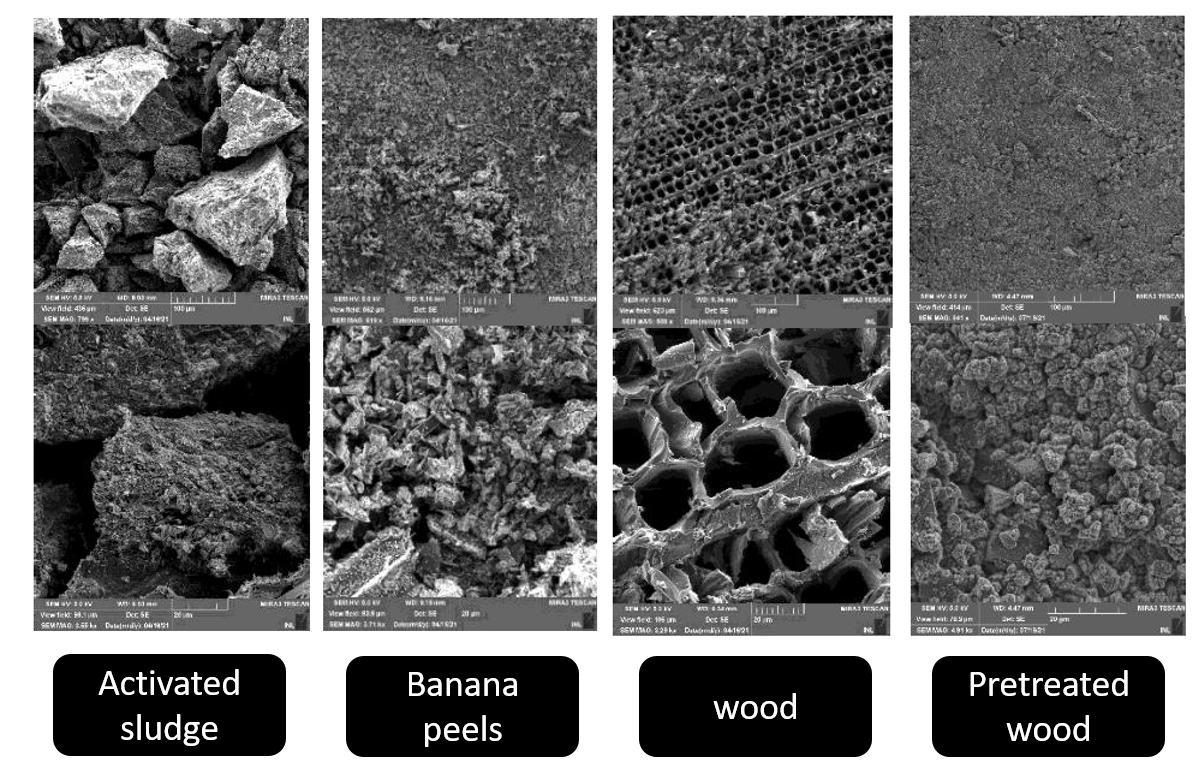
Biochar is gaining more and more attention as it can have interesting physico-chemical properties for multiple applications : soil amendment, chemical catalyst, carbon sequestration, etc. It is very diverse, and strongly depend upon biomass origin. Structural differences are shown at the left image above to illustrate the diversity of biochars.
Its physico-chemical properties depend also on the pyrolysis process :
- (chemical) pretreatment
- pyrolysis time
- pyrolysis gas
- pyrolysis temperature and ramp
- post-treatment
- etc.
Related publications
Journal
- Bataillou, G., Lee, C., Monnier, V. , et al. et al. Cedar Wood-Based Biochar: Properties, Characterization, and Applications as Anodes in Microbial Fuel Cell. Appl Biochem Biotechnol 194, 4169–4186, 2022. DOI: 10.1007/s12010-022-03997-3
Ph.D
- G. Bataillou Biopiles à base de plantes : optimisation multicritère, écoconception et application aux capteurs autonomes These de doctorat Ecully, Ecole Centrale de Lyon, 2023. Online Access