Plant Microbial Fuel cell
How it works
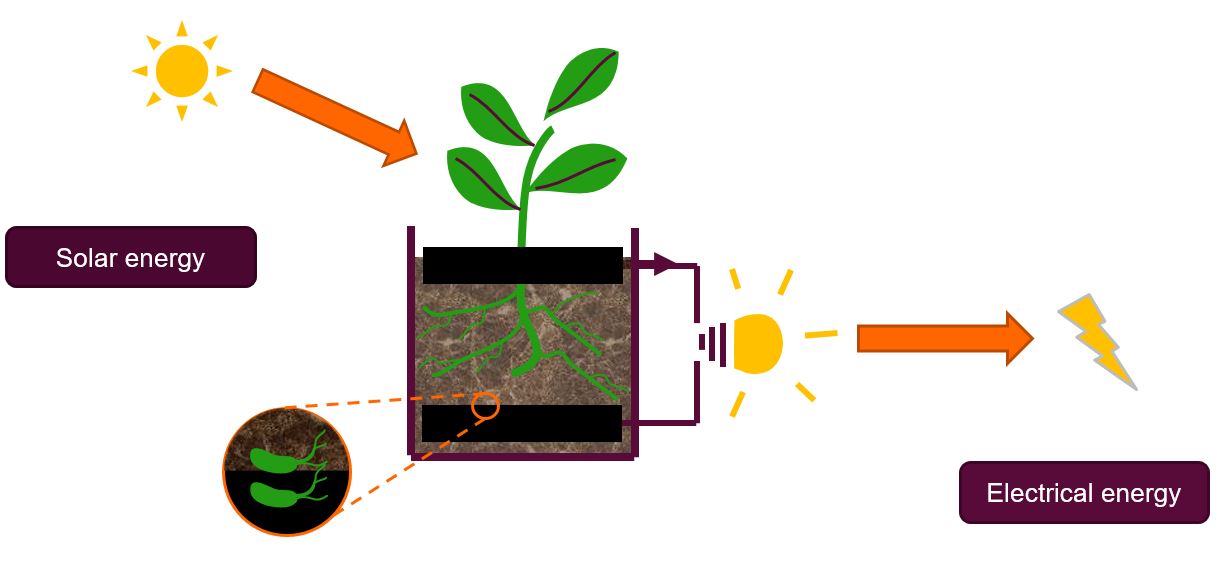
Plant Microbial Fuel Cells (PMFCs) are electrochemical systems that can convert solar energy from electricity via the plant growth! These intriguing systems are based on the combination of two principles : Microbial Fuel Cell and Plant rhizodeposition.
Microbial Fuel Cell
Microbial Fuel Cells are using a specific type of microbes (called exo-electrogens) to extract energy from organic matter (such as glucose, or acetate). Every microrganism that consume organic matter break the carbon-rich molecules, and release electron. To produce energy, they need to close their respiration chain, by giving those released electron to an electron acceptor (usually, dioxygen). The exo-electrogen microbes have developed multiple ways to give their electrons outside their cell, to an extra-cellular electron acceptor. These microbes are present everywhere in the world when oxygen is scarce.
By putting an electrode in a place without oxygen (anode, -), and connecting this electrode with another electrode where oxygen is present (cathode, +), exo-eletrogen microbes can connect to the anode, and give electron to the dioxygen present at the cathode site. this oxido-reduction reaction has a theoretical open circuit voltage of 1.1V (0.8V in real world)!
Rhizodeposition
The second exploited phenomenon in PMFC is Rhizodeposition. When plant grow, they synthesize the organic molecules they need out of photosynthesis. These organics are used to form the upper system (leaves, stem) and soil system (roots). A fraction of root's organic matter is excreted in the soil, due to many reasons : cell lysis (death), ion diffusion in soil, mucilage, etc. This fraction is called "root exudates", and is responsible for a higher microorganism growth in this area.
Combined together, these principles form a system that is powered by the sun :
- The plant makes carbon molecules out of photosynthesis with sun irradiation
- A fraction of it is released with rhizodeposition through the root system
- If an anode is put down the roots and a cathode on top of the soil (exposed to dioxygen from air), the carbon released by the roots can be consumed by the exo-electrogen microbes
Related publications
Journal
- Bataillou, G., Lee, C., Monnier, V. , et al. et al. Cedar Wood-Based Biochar: Properties, Characterization, and Applications as Anodes in Microbial Fuel Cell. Appl Biochem Biotechnol 194, 4169–4186, 2022. DOI: 10.1007/s12010-022-03997-3
- Bataillou, G., Ondel, O., Haddour, N. , 900-Days long term study of plant microbial fuel cells and complete application for powering wireless sensors. Journal of Power Sources 593, 0378-7753, 2024. DOI: 10.1016/j.jpowsour.2023.233965
Conference
- G. Bataillou, N. Haddour, C. Vollaire. Bioelectricity production of PMFC using Lobelia Queen Cardinalis in individual and shared soil configurations. European Fuel Cells and Hydrogen Conference (EFC21) pp.08001, Naples (virtual), Dec 2021. DOI: 10.1051/e3sconf/202233408001 hal-03523799
Ph.D
- G. Bataillou Biopiles à base de plantes : optimisation multicritère, écoconception et application aux capteurs autonomes These de doctorat Ecully, Ecole Centrale de Lyon, 2023. Online Access